Section 1 · Student Ministry
Youth Group Gatherings That Work
How to shape a weekly youth group night that teenagers return to: the arc of an evening, games that include everyone, food and honest talk.
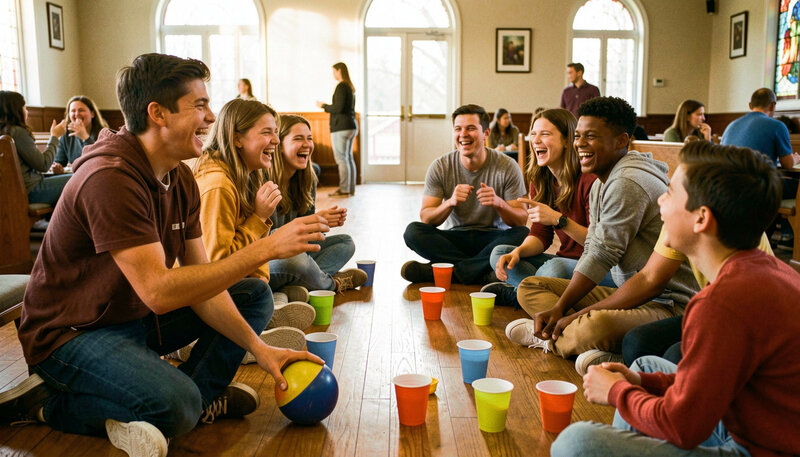
This page keeps a historical address: student ministry gatherings at fbcworland.org once lived at this exact path, when the site belonged to a Wyoming church. The Fellowship Hall reuses the address for the question it has always answered, which is how a weekly youth group night is actually shaped. The short version: an evening that works has an arc, welcome into play into teaching into honest talk into food, run by adults who learn names and watch the room. The long version is below, in the order the evening happens.
Why the first ten minutes decide the night
Students decide within the first ten minutes whether an evening is for them, and the decision is emotional before it is intellectual. The welcome is therefore a real part of the program, not the time before the program. A leader at the door who uses names, a warm room rather than a cold sanctuary, music at a volume that permits talking and an immediate low-stakes activity all say the same thing: you were expected. Students who arrive tense, hungry or fresh from a bad day at school soften when someone notices them quickly and without ceremony. Nothing later in the evening rescues a flat welcome.
Open with games that include everyone
Games are not filler; they are the mechanism that lets a mixed group of teenagers laugh together before anyone is asked to be serious. The best youth group games share three traits: they need no skill to join, they mix the ages rather than sorting them and they let unathletic students shine somewhere. Circle games with plastic cups, group challenges with a soft ball, guessing games and team relays all qualify. Avoid games that eliminate players early and leave them watching, and avoid long rules explanations, because momentum dies in the explanation. Fifteen to twenty minutes of play is usually enough to reset whatever the school day deposited.
How long should the teaching be
Shorter than most leaders think. A teaching built for teenagers carries one idea, uses one concrete example and lands in ten minutes, with the leader standing rather than seated and finishing before the room starts to fade. The teaching is a doorway into conversation, not a destination; its job is to put a workable idea on the table that the small circles can pick up. A leader who wonders what to cut from a twenty-minute draft usually needs to save the extra material for another week. Passage choices and question types that work after the teaching are covered in the Bible study ideas guide.
Make space for honest talk
After the teaching, the evening shifts into small conversation, and this is where a youth group earns its keep. Split into circles of four to eight with an adult who has been briefed to ask rather than lecture. Questions that open teenagers up are questions without a correct answer: what stood out, what was confusing, where have you seen this play out. Silence is allowed to sit for a few seconds, because the second answer is usually more honest than the first. Phones go into a basket or a pocket agreement, and the rule is easier to keep when the conversation is worth having. The craft of these circles, including handling the talker who fills every silence, is developed in the small group guide.
End with food and an unhurried door
Food is ministry infrastructure in a small church. It says the group is a place where bodies are fed as well as souls, it slows the exit and it creates the side conversations where leaders actually learn what is going on. Pizza is the standard because it scales and because nobody negotiates with it, but a rotation of families providing a simple meal works just as well and pulls the congregation into the ministry. The last fifteen minutes, students lingering by the door, leaders saying specific goodbyes by name, are when next week's attendance is quietly decided. End the formal program before the food so the evening can breathe out rather than be cut off.
Who runs the evening and how many adults
A gathering needs at least two adults present from setup to last pickup, both for safety and because one adult alone cannot watch a room and a hallway at once. Roles can rotate: one leads the evening, one floats, both join the small circles. Over time, students take real parts of the night, from running the game to leading a question circle with an adult nearby, which is the progression described in raising student leaders. The screening and two-adult floor that applies to everyone serving minors is laid out in the volunteer guide.
Keep the arc when the group is tiny
A gathering of four students runs the same arc as a gathering of twenty, only faster and closer to a meal together. Do not cancel the structure when the group is small; compress it. The game becomes a table game, the teaching becomes a five-minute setup, the small circle becomes the whole group. Small evenings built this way are the ones students describe as feeling like family, and they are the proof that the arc, not the crowd, is what makes a youth night work. New leaders preparing their first season will find the sequencing help they need in how to build a youth ministry, and the full section map on the student ministry index.