Section 2 · Bible Study
Bible Study and Small Groups
Guides for Bible study in youth groups and adult small groups: choosing passages, asking questions that open teenagers up, and steady formats.

Bible study is where a church's teaching ambition meets the actual attention spans of the people in the room, and nowhere is the gap wider than with teenagers. This section of The Fellowship Hall collects the working guides for that meeting point: how to choose passages that repay discussion, how to ask questions that open students up, and how to run the small groups where most honest Bible reading actually happens. The guides assume no seminary training, a modest budget and rooms that double for storage during the week.
What this section covers
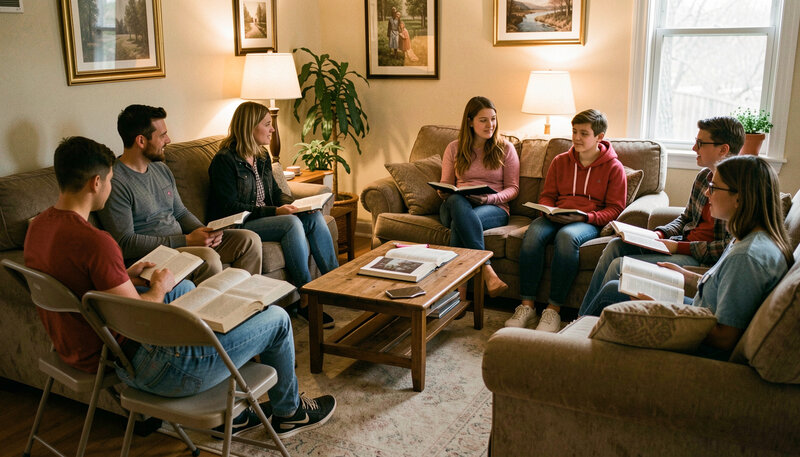
The section stands on two guides. Bible Study Ideas for Teenagers is the format catalog: passage choices that generate conversation, question types that work, short series plans that hold a term together, and the practical handling of phones, doubt and long silences. Small Group Bible Studies is the operations manual for the circle itself: the right size, a repeatable evening shape, the role of the host and what to do about the member who answers every question. Together they cover both what to study and how the studying actually runs.
Why format matters as much as content
A small church does not lack for good material; it lacks for formats that fit its people. A lecture series that works in a seminary chapel dies in a church basement with eight teenagers, not because the content is wrong but because the format fights the audience. Teenagers process out loud, in short bursts, in circles where they can see each other's faces. Adults in a home group process slowly, after the second cup of coffee, once the safe people have spoken. The guides in this section therefore spend as much time on shape, size and pacing as on passage selection, because the shape is what makes the content reachable.
Where study meets the rest of church life
Bible study does not float free of the rest of the ministry. The midweek youth group gathering typically ends in a discussion circle, and the question craft is identical whether the circle sits in a gym or a living room. Students who grow comfortable in a study circle become the natural candidates for student leadership, since leading a question circle is the first real responsibility most young leaders take. And the adults who host home groups are usually the same volunteers who carry the rest of congregational life, which is why their recruitment and care are covered in the volunteer guide rather than treated as a separate species.
Reading the Bible without performing it
One conviction runs through every guide in this section: the goal of study is honest engagement, not correct performance. A circle where a teenager can say "I do not see how this is good news" without the room flinching is a healthier Bible study than one where everyone answers in bulletin language. Leaders therefore practice receiving hard questions as gifts, keeping their own confessions proportionate and letting the text be strange where it is strange. Curiosity, honestly modeled by the adult in the room, is the most contagious teaching method available to a small church.
How much preparation does a leader actually need
The honest answer is less than guilt suggests and more than improvisation allows. A workable preparation for a discussion-based study is an hour: read the passage twice, once for the story and once for what is strange in it, write four questions in your own words, and think of one honest sentence about what the passage has done in your own week. Curricula can add background, but they cannot supply the leader's actual attention, and a leader who has sat with the text for an hour will out-teach a leader who has read a commentary for four. Preparation beyond that hour is a calling, not a requirement, and small churches should not quietly staff their circles as if it were one.
Choosing between a purchased curriculum and your own series
Purchased curriculum earns its price in three situations: a new leader who needs the scaffolding, a season when nobody has preparation time, and topics where the teaching needs a sequence no one in the room could design. Outside those situations, homegrown series built on plain questions usually generate more honest conversation, because the leader chose the passages for these people, in this town, in this season of the church's life. The hybrid most small churches land on is a purchased skeleton with local questions wired in, which respects both the publisher's work and the room's actual life. The decision framework in the resources overview applies here unchanged.
What a year of study should add up to
A single study session is a small thing; a year of them is a formation. Over twelve months, a healthy study ministry should have walked teenagers through at least one whole narrative rather than only scattered excerpts, given adults a vocabulary for doubt that stays inside the room, and produced a handful of members who now read the Bible on their own during the week. Plan the year backward from those outcomes rather than forward from a list of topics, and let the calendar of church activities set the realistic count of teaching weeks, because Advent and graduation eat more term time than any planner expects.
How to use these guides
Start with the ideas guide if the immediate need is what to study next term, or with the small group guide if the need is why the existing circle sputters. Both are written to be read in one sitting and applied the same week. The resources section adds the tool side: reading plans, study apps and podcast formats that support a group between meetings without replacing the circle itself.
Guides in this section

Bible Study
Bible Study Ideas for Teenagers
Passages with tension, question types that open a room, and series that hold a term.
Bible Study
Small Group Bible Studies
Five to ten people, one honest circle, ninety minutes, ends on time.